How-to
How to grow king oyster mushrooms, and how they differ from other oysters
Published
Short answer
King oyster, also sold as king trumpet, grows on a supplemented hardwood sawdust block, not on straw. Colonize the bag for 2 to 3 weeks at 70 to 75 F, then fruit it from the top at 50 to 65 F, under 62 F until pins set. Trim the bag to a 4 to 6 inch collar when the pins are about 1 inch tall. Harvest comes 10 to 20 days after setup, usually as one flush.
Most failed king oyster blocks were treated like a blue oyster kit: an X cut in the side, a warm room, plenty of fresh air and a spray bottle. King oyster wants nearly the opposite. It fruits from the top of the block, in a cool room, inside a bag that stays closed until the pins are up. A ready block or kit skips straight to fruiting. Making the block yourself adds substrate mixing, a pressure cooker and a spawn run. The figures here are compiled from Field & Forest, North Spore and GroCycle growing guides, not measured by this site.
King oyster mushroom vs oyster mushroom: the differences
King oyster (Pleurotus eryngii) belongs to the oyster group but is grown almost the opposite way. The table sets it against blue or pearl oyster, the usual first species. Figures for the other varieties are in oyster mushroom growing conditions.
| Point | King oyster (king trumpet) | Blue or pearl oyster |
|---|---|---|
| Substrate | Sterilized hardwood sawdust with 10 to 15% bran, or masters mix | Pasteurized straw or sawdust blocks, also coffee grounds and cardboard |
| Spawn run | 2 to 3 weeks at 70 to 75 F | 10 to 21 days at 60 to 77 F |
| Fruiting temperature | 50 to 65 F, under 62 F to set pins | 55 to 75 F |
| Where it fruits | Top of the block, inside a 4 to 6 inch bag collar | Side of the block, through an X cut |
| Fresh air | Low until pins form, then CO2 under 2,000 ppm | High from the start: CO2 under 1,000 ppm |
| Growth form | Single mushrooms with thick stems and small caps | Clusters of caps on short stems |
| Time to harvest | 10 to 20 days after setup | Pins in about 1 week, harvest 5 to 10 days later |
| Flushes | Usually one | 2 to 4, each smaller |
King oyster mushroom grow kit or your own block
A king oyster mushroom growing kit is a bag of fully colonized substrate that is ready to fruit. It skips substrate making and the spawn run, so begin at step 5 below. Start it within a week of arrival. If it has to wait, refrigerate it and follow the label, because storage times differ by seller.
Making the block yourself needs hardwood fuel pellets, wheat or rice bran, a filter patch grow bag, king oyster grain spawn, and a pressure cooker that reaches 15 psi. King oyster is a sawdust species in the supplier guides checked, so do not use the straw method that works for other oysters. For more than one block, the substrate calculator scales the recipe. The heat step is explained in how to sterilize mushroom substrate.
How to grow king oyster mushrooms at home: steps
The amounts make one 5 lb block. Spawn is the grain carrying the living mycelium, the spawn run is the time it takes to colonize the block, pins are the first tiny mushrooms, and a flush is one crop. With a kit or ready block, begin at step 5.
- 1
Mix the substrate: 1.66 lb of hardwood pellets, 0.3 lb of bran (15% of the dry weight) and 1.4 liters of water, about 6 cups. Let the pellets break down. A squeezed handful should give only a drop or two.
- 2
Fill a filter patch bag and sterilize it for 2.5 hours at 15 psi. One king oyster guide uses 3 hours. Follow the cooker's manual, and let it cool for about 8 hours before opening.
- 3
On a wiped surface, add grain spawn at about 5% of the wet weight: 4 oz for a 5 lb block. Published rates run from 2 to 10%. Mix it through and seal the bag.
- 4
Keep the bag at 70 to 75 F, out of direct sun, for 2 to 3 weeks until the block is white throughout. The core of the bag should never go above 90 F.
- 5
Move the closed bag to a cool place at 50 to 65 F, under 62 F until pins have set, with 10 hours or more of indirect light a day. Do not cut the side of the bag.
- 6
Watch the top surface. Pins show 4 to 14 days after the move. When they are about 1 inch tall, cut off the top of the bag and leave a collar 4 to 6 inches above the block.
- 7
Keep the air around the block moist without wetting the mushrooms. Mist the room air or the inside of the collar. Do not water the caps or stems directly.
- 8
Harvest 10 to 20 days after setup. Twist and pull each mushroom or cluster off the block, then trim the sawdust from the base.
Why the bag stays closed and the room stays cool
The closed bag does two jobs. It holds humidity at the block surface, and king oyster pins are sensitive to low or changing humidity. It also holds carbon dioxide, and a high-CO2 start is what gives king oyster its thick stem and small cap. The collar left after trimming keeps that pocket of still, moist air.
Cool air matters as much. Field & Forest sets pins below 62 F and warns that above 65 F king oyster is prone to bacterial blotch: rust-colored streaks on the stems and discolored patches on the caps. Direct watering adds to the risk.
Sources differ on room humidity. North Spore and GroCycle quote 95 to 100% while pins form and about 85 to 95% afterwards. Field & Forest fruits its ready blocks in a room at 65% or less and relies on the tall collar. Both aim at moist air at the pins and dry caps. Per-source figures are in the growing temperature chart.
Do you need to thin king oyster pins?
Thinning is optional. Some growers remove the smallest pins early so the rest grow larger. Field & Forest states that pin selection is not necessary with its king oyster culture, and the other guides checked for this page do not call for it. None of them gives a number of pins to keep, so none is given here. If the stems come out thin, look at temperature and the collar first: the guides tie thick stems to the closed, high-CO2 start.
How to tell king oysters are ready to harvest
Pick when the caps have begun to flatten but the edges are still curled under. Field & Forest words it as the cap almost fully open and flat. Size is not the sign: the cap edge is. Harvest the whole block at once.
After the harvest, expect little more. King oyster usually gives one flush. Field & Forest treats it as a single-fruiting variety and sends finished blocks to the compost, while GroCycle says two to three flushes are possible. Across species, suppliers report 0.5 to 2 lb from the first flush of a 5 lb block, which is a range and not a promise. Options for the spent block are in can you reuse mushroom substrate. Cook the mushrooms before eating.
Mistakes carried over from other oyster mushrooms
Each habit below works for side-fruiting oysters and against king oyster. If a block has stalled, check these five points first.
- Cutting an X in the side of the bag. King oyster fruits from the top surface, inside the bag.
- Fruiting at room temperature. Pins set under 62 F, and blotch becomes likely above 65 F.
- Opening the bag at the start for fresh air. Keep it closed until the pins are about 1 inch tall.
- Spraying the mushrooms. Mist the air or the collar, never the caps and stems.
- Planning on straw. In the supplier guides checked, king oyster is grown on supplemented sawdust.
Note.Green or blue-green powder, black dots or a sour smell on the block is contamination, not a fruiting problem. Isolate the block and discard it outdoors.
Quick answers
Short answers on growing king oyster, also sold as king trumpet. Ranges are compiled from supplier guides, not measured by this site.
- King oyster vs oyster mushrooms: what is the main difference? King oyster fruits from the top of a sawdust block at 50 to 65 F. Other oysters fruit from the side at 55 to 75 F and also grow on straw.
- Is a king oyster mushroom grow kit easier? Yes. A kit is a colonized block, so only the cool fruiting stage is left. Expect a harvest 10 to 20 days after setup.
- How long does growing king oyster mushrooms take? From spawn, 2 to 3 weeks of spawn run plus 10 to 20 days of fruiting, so about 4 to 6 weeks.
- Can you grow king oyster mushrooms at home in a warm room? Not well. Above 62 F pins may not set, and above 65 F bacterial blotch becomes likely.
What you need for this
 See price on AmazonAmazon
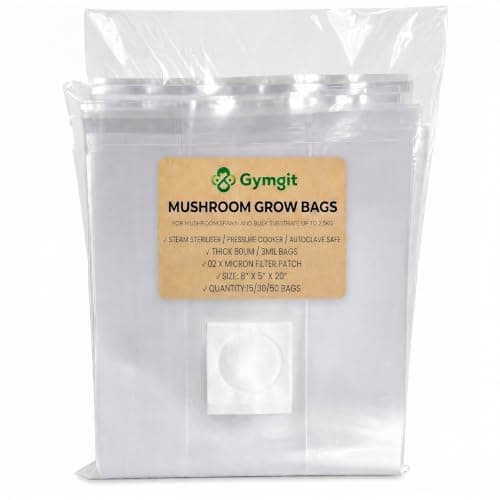
Gymgit grow bags 8 x 5 x 20 in, 0.2 micron, 30 pack
From Best filter patch grow bags for oyster, shiitake and lion's mane blocks
 See price on AmazonAmazon
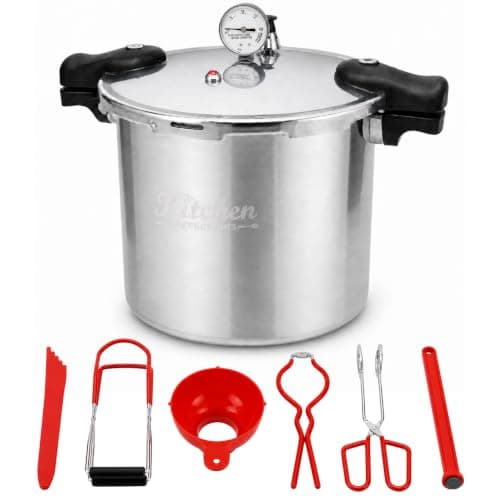
Kitchen Affections 24 qt canner kit, 10 and 15 psi
From Best pressure cookers for sterilizing sawdust blocks at home
 See price on AmazonAmazon
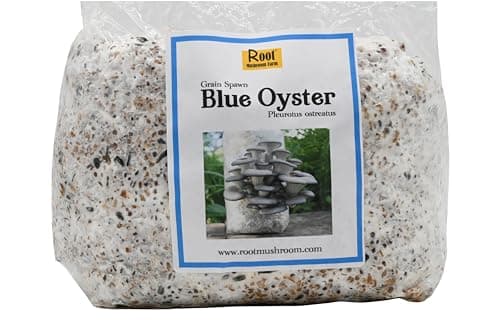
Root Mushroom Farm blue oyster grain spawn, 5.5 lb
 See price on AmazonAmazon
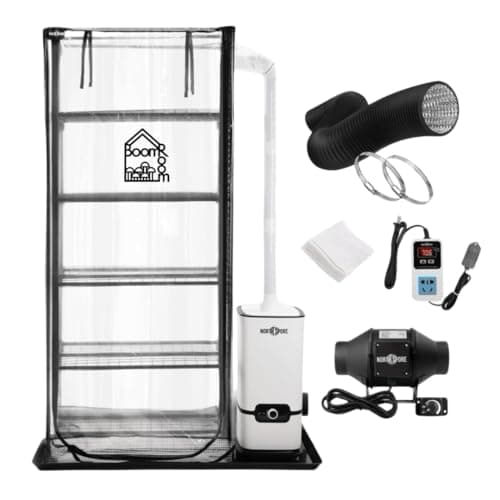
North Spore BoomRoom II automated tent, 5 racks
From Best mushroom growing tents and small fruiting chambers