Chart
Lion's mane growing and fruiting conditions, with numbers
Published
Short answer
Lion's mane colonizes its block at 68 to 75 F in 2 to 3 weeks, then fruits at 55 to 70 F. Every source checked agrees on 55 to 65 F. Keep humidity at 90 to 95% while pins form and 80 to 90% while the mushroom grows, with steady fresh air and 8 to 12 hours of indirect light. Mist the air around it, not the mushroom.
These numbers are for lion's mane (also written lions mane) grown indoors on a sawdust block or a grow kit. They come from three supplier guides: North Spore, Field & Forest Products and GroCycle. The guides agree closely on temperature and disagree on humidity, so the chart gives ranges and names who says what. Two things decide the result more than a degree either way: fresh air, because lion's mane deforms in stale air, and how the water reaches it, because wet spines turn brown. If the label on your spawn or kit gives its own range, the label wins.
Lion's mane growing conditions by stage
The chart follows one indoor block through three stages. Spawn run (colonization) is the time the mycelium spends growing through the sawdust in a closed bag. Pins are the first tiny mushrooms, which on lion's mane look like small white knobs. Fruiting is the growth from pin to harvest.
| Condition | Spawn run | Pin formation | Fruiting |
|---|---|---|---|
| Temperature | 68 to 75 F (20 to 24 C). GC 68 to 75, FF 68 to 72 | 55 to 70 F (13 to 21 C) | 55 to 70 F. NS 55 to 70, FF 55 to 65 on ready blocks |
| Humidity | Bag closed, no misting | 90 to 95% (NS) | 80 to 90% (NS). GC 85 to 90%, FF 70 to 85% |
| Fresh air (CO2) | Through the filter patch only | High: 500 to 700 ppm (NS) | Under 1,000 ppm (NS) |
| Light | A dark, warm spot (GC) | 8 to 12 hours indirect (FF) | 8 to 12 hours indirect (FF) |
| Time | 12 to 20 days, about 2 to 3 weeks | 3 to 7 days in a tent, 12 to 18 days on a kit | 5 to 10 days from pins to harvest |
What temperature does lion's mane need to grow and fruit?
Lion's mane wants two temperatures. The spawn run is warm: 68 to 75 F (GroCycle), or 68 to 72 F on the Field & Forest sheet. Fruiting is cooler: North Spore prints 55 to 70 F, and Field & Forest gives 55 to 65 F for its ready blocks and 55 to 70 F for home-made ones. The band all of them share is 55 to 65 F. A room at 68 to 70 F is still inside the span, at its warm edge. Growth runs faster when warm and slower when cool.
During the spawn run the block makes its own heat. Keep the room in range and leave space between bags so the core of a bag never passes 90 F. To see whether your room suits lion's mane or another species better, enter its temperature in the growing temperature chart.
What humidity do lions mane mushrooms need?
Humidity is where the guides disagree most: the figures run from 70 to 95%. North Spore gives 90 to 95% while pins form and 80 to 90% for fruiting. GroCycle gives 85 to 90%. Field & Forest accepts 70 to 85% and tells growers to mist daily when the air is drier than that. Aiming for 85 to 90% keeps you inside most of these ranges.
On a kitchen counter, mist 2 to 4 times a day and cover the kit with a humidity tent: a loose plastic bag with plenty of 1/2 inch holes. In a growing tent, a humidifier on a controller set to switch on near 70% and off near 90% averages about 85%.
Note.Mist the air and the inside of the tent, not the mushroom. Water left sitting on the spines is the usual cause of dark, wet brown patches.
Fresh air and light in lion's mane fruiting conditions
North Spore lists lion's mane at 500 to 700 ppm of CO2 while pins form and under 1,000 ppm after that, which in plain words means a lot of fresh air. Few home growers own a CO2 meter, so read the shape instead. Field & Forest notes that mushrooms come out malformed without enough air exchange. A kit in an open room usually gets enough. A tent needs plenty of holes or a few minutes open several times a day. A closet or cabinet does not work.
Lion's mane needs light, but not much: Field & Forest asks for 8 to 12 hours a day of indirect sun or added lighting. Keep the block out of direct sunlight and away from heat sources, which dry the mushroom out as it develops.
Yellow, brown, pink or coral-like: what the mushroom is telling you
Lion's mane shows a wrong condition in its color and shape before it stops growing. Match what you see to the row, then change that one thing and watch the next few days of growth.
| What you see | Likely cause | What to do |
|---|---|---|
| Yellow or light brown, dry-looking surface on a young mushroom | Air too dry (FF, GC) | Mist more often or add a humidity tent |
| Dark brown or orange patches that look wet | Water sprayed on the mushroom and left to sit (GC) | Mist the air from farther away. Do not eat fruit that has gone soft and wet |
| Yellow top on a full-size mushroom with long spines | It is mature (NS, GC) | Harvest now. Spines of 1/4 to 1/2 inch mean ready |
| Coral-like branches, stretched growth, no spines | Too little fresh air (FF) | Open the tent more, add holes, move it out of any cabinet |
| Light pink tint | Cool room, per Fat Fox. Bright pink: direct sun | Not a fault. Move the kit out of direct sun |
| White knobs inside the closed bag | The species pins early, or the kit was stored for weeks (NS) | Cut the X beside them and start fruiting conditions |
What to do when lion's mane is fruiting early in the bag
Lion's mane often sets pins inside the bag before the block looks finished. Its mycelium is thin and faint, so a healthy block can look half bare when it is ready. Redwood Mushroom Supply's growing guide suggests cutting a small X next to the pins when the bag looks mostly colonized, and letting them grow from there. North Spore's kit advice is to break off any early mushrooms you can reach and start fresh at the cut.
To make early pinning less likely on a home-made block, the same guide says to press the air out of the bag and keep it in the dark during the spawn run. The full sequence from knob to harvest is in lion's mane growth stages.
From pins to harvest, and the next flush
Once pins show, harvest is 5 to 10 days away. Pick when the spines are 1/4 to 1/2 inch long and before the top yellows: twist the whole cluster off the block. Then keep the same conditions. A flush is one crop, and the next one usually starts after 2 to 3 weeks of rest. If the block has dried out, soak it for 5 to 15 minutes only, because the delicate mycelium breaks apart in a long soak. Expect 2 to 4 flushes, each smaller. The setup steps are in how to grow lion's mane.
Quick answers
The short version of the chart, for the questions growers ask most. All figures are ranges from the supplier guides named above.
- What is the lion's mane mushroom growing temperature? 68 to 75 F for the spawn run, then 55 to 70 F for fruiting. Every source checked agrees on 55 to 65 F.
- What humidity do lions mane mushrooms need? 90 to 95% while pins form and 80 to 90% while they grow, per North Spore. Field & Forest accepts 70 to 85% with daily misting.
- What are lion's mane fruiting conditions in one line? 55 to 70 F, 80 to 95% humidity, CO2 under 1,000 ppm and 8 to 12 hours of indirect light.
- Why is my lions mane fruiting early? The species tends to pin inside the bag before the block looks white. Cut an X beside the pins and move it to fruiting conditions.
- Why is my lion's mane turning yellow or brown? Dry air, water sprayed on the mushroom, or plain maturity. Check the spines: at 1/4 to 1/2 inch it is time to harvest.
Use this chart
Print it, save the image version, or put it on your own site or forum post with the code below. The code keeps a link back to this page as the source.
Embed code
<a href="https://spawnrun.com/blog/lions-mane-growing-conditions"><img src="https://spawnrun.com/charts/lions-mane-growing-conditions/image.png" alt="Lion's mane growing and fruiting conditions, with numbers" width="600" loading="lazy"></a>
<p>Source: <a href="https://spawnrun.com/blog/lions-mane-growing-conditions">Lion's mane growing and fruiting conditions, with numbers</a>, Spawn Run</p>
What you need for this
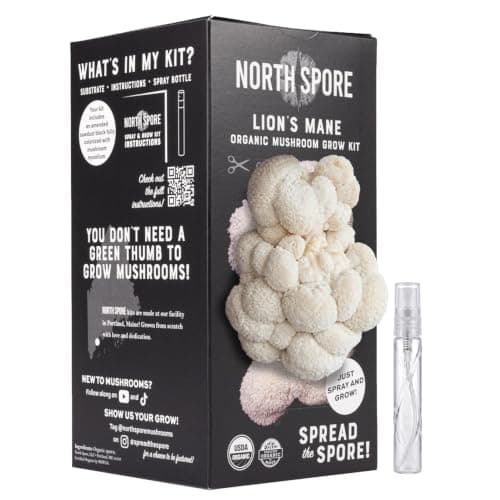 See price on AmazonAmazon
North Spore lion's mane spray and grow kit, 4 lb
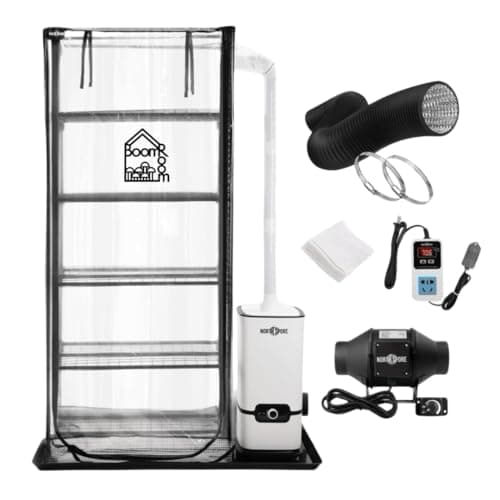 See price on AmazonAmazon
North Spore BoomRoom II automated tent, 5 racks
From Best mushroom growing tents and small fruiting chambers
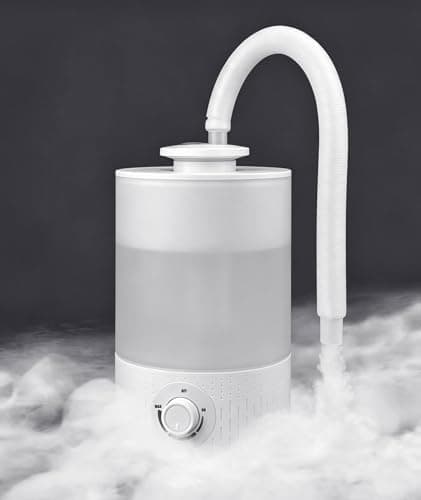 See price on AmazonAmazon
Sighthal 3 L ultrasonic tent humidifier, two hoses
From Best humidifiers and humidity controllers for a mushroom tent