Explainer
Lion's mane growth stages, day by day, and when to harvest
Published
Short answer
A lion's mane block colonizes in 2 to 3 weeks, forms pins 3 to 7 days after the bag is cut in a humid tent (12 to 18 days for a kit in a room), and is ready 5 to 10 days after the pins appear. Harvest when the spines are 1/4 to 1/2 inch long and still white, before any yellowing.
This page is for a grower looking at a lion's mane (lions mane) kit or sawdust block and asking two things: is this normal, and is it time. The stages below follow one flush, which is one crop of mushrooms, from the colonized block to the second harvest. The day ranges come from supplier growing guides, so read them as ranges, not promises. Temperature, humidity and fresh air decide where in each range your block lands. Across suppliers the fruiting range is 55 to 70 F.
Lions mane growth stages and growth time at a glance
From fresh spawn to the first harvest takes about 3 to 7 weeks on a sawdust block. A ready kit skips the first stage, because it arrives colonized. The table gives each stage with its usual length and what the block should look like.
| Stage | Usual time | What you see |
|---|---|---|
| Spawn run (colonization) | 12 to 20 days at 68 to 75 F | Thin, faint white mycelium spreads through the sawdust |
| First pins | 3 to 7 days after opening in a tent, 12 to 18 days for kits | Small white knobs at the cut in the bag |
| Ball stage | First part of the 5 to 10 days from pins to harvest | A dense white lump, like a small cauliflower, bigger each day |
| Spine formation | Last part of the same 5 to 10 days | Short soft spines appear and point downward |
| Harvest window | 5 to 10 days after pins | Spines 1/4 to 1/2 inch long, still white |
| Rest | 2 to 3 weeks | Bare block, no growth at the cut |
| Second harvest | After the rest, same pins-to-harvest time | A smaller mushroom than the first |
Stage 1: the colonized block after the spawn run
Spawn is the living culture that is mixed into the sawdust. The spawn run, also called colonization, is the time the mycelium takes to grow through the block: 2 to 3 weeks for lion's mane at 68 to 75 F. Lion's mane mycelium is thin and faint, so a finished block can look patchy next to a dense white oyster block. That is normal. Amber droplets on the surface are also a healthy sign.
A kit has already done this stage. Start it within a week of arrival, or follow the label if you need to keep it in the refrigerator first. If you are making your own block, the full method is in how to grow lion's mane at home. Green, black or orange patches are not a growth stage: see mold on a mushroom block.
Stage 2: first pins after the bag is cut
Pins are the first tiny mushrooms. Lion's mane fruits from the side of the block, through an X cut in the bag. In a humid tent the pins show 3 to 7 days after the cut. A kit on a kitchen counter, or a supplier block in a grow room, usually takes 12 to 18 days. During this stage keep the air at 90 to 95% humidity and the room at 55 to 70 F, with 8 to 12 hours of indirect light. The growing conditions chart shows these figures by source.
No pins after three weeks usually means the cut surface is too dry. The fixes are in why a kit is not growing. Every number for this species sits in one place in lion's mane growing conditions.
Stage 3: ball stage and spine formation
Once pins form, the mushroom swells into a white ball that is visibly bigger each day. At first it looks like a small cauliflower, with a bumpy surface and no spines. Later in the 5 to 10 days from pins to harvest, soft spines form on the surface and begin to hang down. How fast this goes depends on temperature.
Humidity can drop to 80 to 90% now. Suppliers disagree on this figure more than on any other for lion's mane, from 70 to 95%, so use the label of your kit if it gives one. Mist the air around the mushroom 2 to 4 times a day, not the mushroom itself. A mushroom that grows in an odd, malformed shape needs more fresh air.
Note.Yellow or brown patches during this stage point to water sprayed straight onto the mushroom or to dry air. Raise the humidity and mist the tent walls instead of the mushroom.
When is lions mane ready to harvest?
The rule in one line: harvest when the spines are 1/4 to 1/2 inch long and the mushroom is still white, before any yellowing. One supplier adds a touch test: the mushroom feels spongy when squeezed gently. This point usually comes 5 to 10 days after the pins appeared. Size is not the sign. A small mushroom with half-inch spines is ready, and a large one with no spines is not.
- Too early: a smooth or bumpy ball with no visible spines. Wait a day and check again.
- Ready: spines 1/4 to 1/2 inch long, hanging down, white all over. Pick now.
- Late: spines longer than 1/2 inch, the top or the tips turning yellow or brown, or a white dust under the mushroom. Pick at once. Quality and shelf life drop from here.
How to harvest lion's mane
Take the whole mushroom in one piece, with clean hands or a clean knife. A mature lion's mane comes off the block easily, so the job takes about a minute.
- 1
Wash your hands. Slide your fingers behind the mushroom, between it and the bag, and hold it close to its base.
- 2
Twist gently and pull the mushroom off the block. If you prefer, cut it off close to the block with a sharp, clean knife in one pass.
- 3
Pick any leftover pieces of mushroom off the cut, so the surface of the block is clean before you mist again.
- 4
Put the mushroom in a paper bag or another breathable container in the refrigerator right away, and cook it before eating.
Second harvest: how long until the next flush?
Leave the block where it is and keep the same conditions. New pins usually come after a rest of 2 to 3 weeks, and the second mushroom then needs the same 5 to 10 days to mature. If the block feels light and dry, soak it for 5 to 15 minutes and let it drain with the cut side down before it goes back in the tent.
Expect 2 to 4 flushes, each smaller than the one before. One supplier counts 4 to 6 from its own blocks in a controlled grow room. The block is finished when it stops pinning or molds over. What it is still good for is covered in reusing mushroom substrate.
Quick answers
Short answers to the questions growers ask most about the lion's mane growth cycle and harvest, using the same ranges as the stages above.
- What is the lions mane growth time from start to harvest? About 3 to 7 weeks on a sawdust block: 2 to 3 weeks of spawn run, then pins, then 5 to 10 days to maturity. A ready kit skips the spawn run.
- When to pick lions mane mushrooms? When the spines are 1/4 to 1/2 inch long and the mushroom is still white. Do not wait for more size once the spines have formed.
- How to harvest lion's mane? Twist and pull the whole mushroom off the block, or cut it close to the base with a clean knife. Clear leftovers from the cut.
- What is the life cycle of lion's mane on a block? Spawn colonizes the sawdust, pins form at the cut, the ball grows spines, you harvest, and the block rests 2 to 3 weeks before it fruits again.
- Why is my lion's mane turning yellow before harvest? It was sprayed directly, the air is too dry, or it is past maturity. Pick it and correct the humidity for the next flush.
What you need for this
 See price on AmazonAmazon
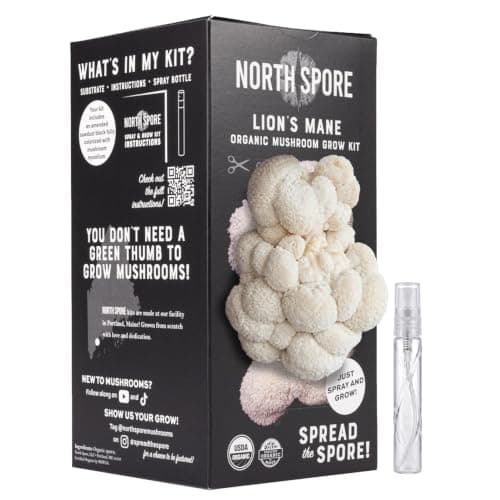
North Spore lion's mane spray and grow kit, 4 lb
 See price on AmazonAmazon
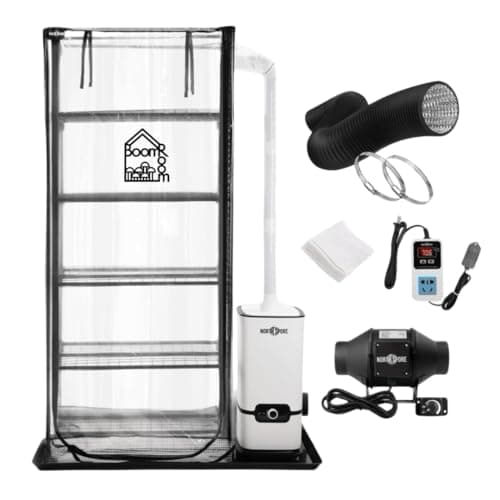
North Spore BoomRoom II automated tent, 5 racks
From Best mushroom growing tents and small fruiting chambers
 See price on AmazonAmazon
Sighthal 3 L ultrasonic tent humidifier, two hoses
From Best humidifiers and humidity controllers for a mushroom tent